
LCD Display Modules for Industrial Automation and HMI Panels
An HMI panel fails on three things: the interface does not match the controller, the panel washes out in a bright plant, or the module stops at 0 °C in an unheated cabinet. We build 4.3" to 15.6" modules with RGB, LVDS and MIPI interfaces, brightness up to 500 cd/m² and operating ranges down to -40 °C, so those three decisions can be made independently of each other.
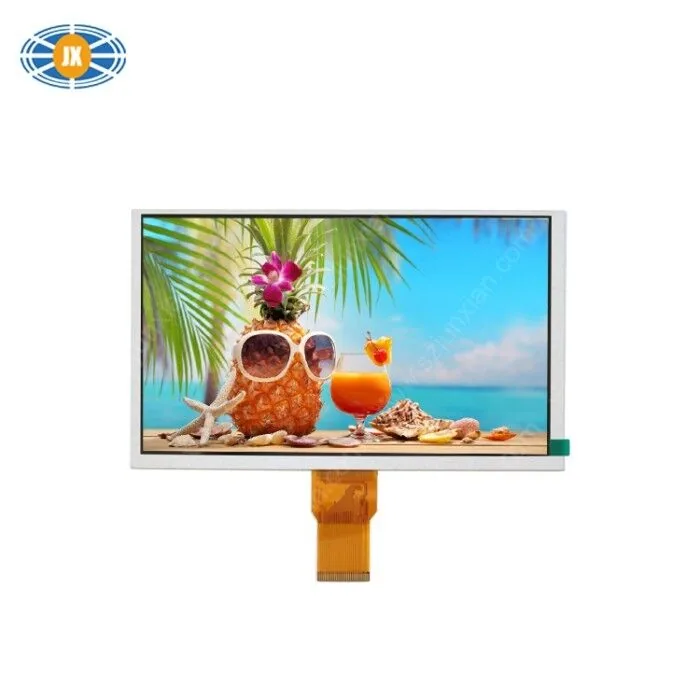
Model, size and rating figures on this page are read directly from the specifications of our published models - the same numbers appear on each product page. Of the 188 models in our current production list, 68 are tagged internally for this application; the 34 below are the ones with a full English specification published so far.
What this application actually demands
| Requirement | Why it decides the design | What we build |
|---|---|---|
| Interface | Must match what your SoC or panel controller already drives - an adapter board adds cost and a failure point. | RGB 8/16/24-bit, MIPI (incl. 4-lane), LVDS, HDMI, MCU 8-bit, SPI |
| Brightness | Plant lighting and window glare decide this, not the datasheet minimum. | 100 to 500 cd/m² across the range; 300 cd/m² and above on most 7" and 10.1" parts |
| Operating temperature | Unheated cabinets in winter are the usual failure case. | -20 °C to +70 °C as standard; -40 °C to +70 °C on wide-temperature parts |
| Touch | Gloved operation rules out some capacitive stacks and thin cover glass. | Capacitive (CTP) or resistive, bonded in-house; cover glass thickness is specified per project |
| Viewing | Panels are read from below on a machine, from above on a desk console. | IPS on most parts for stable colour off-axis; TN where cost dominates |
Models that fit
Selection rule: 4" and larger, and either a parallel display interface a panel controller can drive directly (RGB, LVDS, MIPI or HDMI) or an operating range starting at -20 °C or colder. Nothing else is filtered - if a published model meets that rule it is in this table, and you can check it against the specification on the product page. Values are typical at 25 °C.
| Model | Size | Resolution | Interface | Brightness | Touch | Operating temp |
|---|---|---|---|---|---|---|
| JM-PT074 | 10.1" | 1024×600 | RGB | 400 cd/m² | With CTP Cover Glass Dimension: Customizable | -20°C to +70°C |
| JM-PT125-00 | 10.1" | 800×1280 | MIPI | 500 cd/m² | Optional TP | -20°C to +60°C |
| JM-PT134-01 | 10.1" | 800×1280 | MIPI | 550 cd/m² | selectable | -10°C to +50°C |
| JM-PT134-02 | 10.1" | 800×1280 | MIPI | 500 cd/m² | selectable | -10°C to +50°C |
| JM-PT144-00 | 9" | 1024×600 | RGB-stripe | 300 cd/m² | Customizable Touch | -20°C to +70°C |
| JM- PT114- TI1024600 CML070 | 7" | 1024×600 | 4-lane MIPI | 400 cd/m² | Selectable | -20°C to +70°C |
| JM-GD814 | 7" | 1024×600 | HDMI | 300 cd/m² | Capacitive Touch | -10°C to +70°C |
| JM-GD824-00 | 7" | 1024×600 | RGB/TTL | 350 cd/m² | Selectable | -10°C to +60°C |
| JM-PT034 | 7" | 1024×600 | RGB Vertical Stripe | 300 cd/m² | CTP Touch Screen | -10°C to +70°C |
| JM-PT042-TT800480CRL070 | 7" | 800×480 | TTL | 500 cd/m² | Selectable | -20°C to +70°C |
| JM-PT091 | 7" | 1024×600 | RGB | 450 cd/m² | Capacitive Touch | -10°C to +50°C |
| JM-PT091-00 | 7" | 1024×600 | RGB/TTL | 450 cd/m² | Selectable | -10°C to +50°C |
| JM-PT098-00 | 7" | 800×480 | RGB 8bit | 450 cd/m² | Customizable Touch | -20°C to +70°C |
| JM-PT121-01 | 7" | 800×480 | RGB | 250 cd/m² | CTP Touch Screen | on request |
| JM-PT135-00 | 7" | 1024×600 | RGB | 350 cd/m² | No Touch Screen Or Touch Screen For Optional | -10°C to +60°C |
| JM-PT135-00 | 7" | 1024×600 | RGB | 350 cd/m² | No Touch Screen Or Touch Screen For Optional | -10°C to +60°C |
| JM-PT135-01 | 7" | 1024×600 | RGB | 500 cd/m² | Selectable | -10°C to +60°C |
| JM320240A | 5.7" | 320×240 | - | High Brightness | - | -20°C to +70°C |
| JM240128C | 5.2" | 240×128 | Emulator | 200 cd/m² | Without Touch Screen (Customizable) | -20°C to +70°C |
| JM-PT069 | 5" | 800×480 | Parallel RGB 24-bit | 500 cd/m² | No Touch Screen Or Touch Screen For Optional | -20°C to +70°C |
| JM-PT128-00 | 5" | 480×854 | MIPI | 300 cd/m² | Customizable Touch | -20°C to +70°C |
| JM-PT136-00 | 5" | 800×480 | Parallel RGB 8-bit | 500 cd/m² | No Touch Screen Or Touch Screen For Optional | -20°C to +70°C |
| JM-TFT050BI52 | 5" | 800×480 | RGB | 500 cd/m² | Customizable Touch | -20°C to +70°C |
| JM240128C09-GSBLWNG5 | 5.0" | 240×128 | 8080-8bit | 200 cd/m² | - | -20°C to +70°C |
| JMT050WQ3TNN-01 | 5" | 480×272 | Parallel RGB 24-Bit | 500 cd/m² | Customizable Touch | -20°C to +70°C |
| JM-PT097 | 4.45" | 480×854 | MIPI | 400 cd/m² | Touch-screen And No Touch Screen For Optional | -20°C to +70°C |
| JM-LH018-00 | 4.3" | 800×480 | UART Serial Port | 250 cd/m² | Capacitance touch | -20°C to +70°C |
| JM-PT042 | 4.3" | 800×480 | RGB 24BIT | 260 cd/m² | Selectable | -20°C to +70°C |
| JM-PT089 | 4.3" | 800×480 | RGB 24BIT | 280 cd/m² | Touch-screen And No Touch Screen For Optional | -20°C to +70°C |
| JM-PT104-00 | 4.3" | 480×272 | RGB | 250 cd/m² | No Touch Screen Or Touch Screen Optional | -20°C to +70°C |
| JM-PT105-01 | 4.3" | 480×272 | RGB 8BIT | - | Selectable | -20°C to +70°C |
| JM-TFT043BI051 | 4.3" | 480×272 | RGB | 250 cd/m² | Touch-screen And No Touch Screen For Optional | -20°C to +70°C |
| JM19264C | 4.3" | 192×64 | - | 200 cd/m² | Customizable | -20°C to +70°C |
| JM-PT154-02 | 4.0" | 480×800 | RGB/TTL | 300 cd/m² | Selectable | -20°C to +70°C |
Not seeing the combination you need? 188 models are in production and roughly 120 new ones are developed each year, so ask before assuming it does not exist.
Three things that go wrong
Written from the enquiries we have to correct most often.
Choosing the interface last
The interface is the one parameter you cannot change late without redesigning the carrier board. If your processor has no LCD controller, an RGB panel needs a bridge IC; if it has one, a serial smart module wastes it. Decide this before the size.
Specifying brightness from the office
A 250 cd/m² panel that looks fine on a desk is unreadable next to a factory window. Our range runs 100 to 500 cd/m²; above roughly 400 cd/m² backlight current and thermal load both climb, so oversizing brightness costs power and lifetime.
Leaving no margin on temperature
A -20 °C part in a cabinet that reaches -25 °C at night will not simply run slower - response time collapses and the display may not start. Specify the coldest expected ambient, not the average; we have -40 °C parts where that margin is needed.
What we can change - and what we cannot
Changed on a catalogue panel
FPC length, pin order and exit direction; connector type; backlight brightness and colour; touch panel and cover glass; driver IC selection within what the glass supports; PCBA and firmware on smart serial modules. These start at 100 pcs and do not need new glass tooling.
Needs new tooling
A new glass size or shape, a custom segment layout, a new touch sensor pattern. Tooling MOQ is 1,000 pcs and we quote the tooling cost separately so you can see what is one-off and what is per-piece.
What we will not claim
We do not quote a panel we cannot build to your temperature, brightness and lifetime figures at the same time. If one of the three has to give, we say which one before you order samples rather than after.
Commercial terms
Sample 5 pcs in 10-15 days; production 100 pcs in 10-20 days. EXW, FOB Shenzhen, CIF. T/T, L/C, PayPal. Packed as anti-static bag + foam tray + export carton.
Product categories used in this application
TFT LCD Display Modules
Colour TFT and IPS modules from 0.96" to 15.6" with MCU, SPI, RGB, LVDS and MIPI interfaces.
36 modelsLCD Touch Screen Modules
TFT modules with bonded capacitive (CTP) or resistive touch panels for industrial HMI.
22 modelsSmart Serial UART LCD Modules
Display modules with on-board controller and UART command set - including BMS protocol screens.
5 modelsIndustrial Automation & HMI displays - questions
Which interface should I use for an industrial HMI?
Use RGB or LVDS when your processor has a built-in LCD controller and you want the cheapest panel; use MIPI for higher resolutions on modern SoCs; use a UART smart module when the host is a small MCU with no display capability and you want to send commands instead of pixels. We build all four, so the choice can follow your hardware rather than our stock.
Do you have wide-temperature panels for outdoor cabinets?
Yes. Standard parts are rated -20 °C to +70 °C and wide-temperature parts -40 °C to +70 °C, with storage to +85 °C. The operating range of every published model is in the table on this page.
Can the touch panel be used with gloves?
It depends on the glove and the stack. Thin cover glass with a tuned capacitive controller works with most thin gloves; thick or wet gloves are more reliable on resistive touch. Tell us the glove type and we will specify the stack rather than guessing at the datasheet stage.
What is the minimum order quantity?
Samples 5 pcs, catalogue models 100 pcs, fully custom tooling 1,000 pcs. Lead time is 10-20 days for production and 10-15 days for samples.
Will this model still be available in five years?
Ask before you design it in. Industrial programmes outlive consumer panel cycles, so we mark the parts we can commit to on a multi-year basis and tell you where a panel is tied to a glass source we do not control. We would rather say so early than issue an end-of-life notice mid-programme.
Need a quote or a datasheet?
Send us size, resolution, interface and annual quantity. Our engineers reply within one working day. Sample MOQ 5 pcs, lead time 10-20 days.